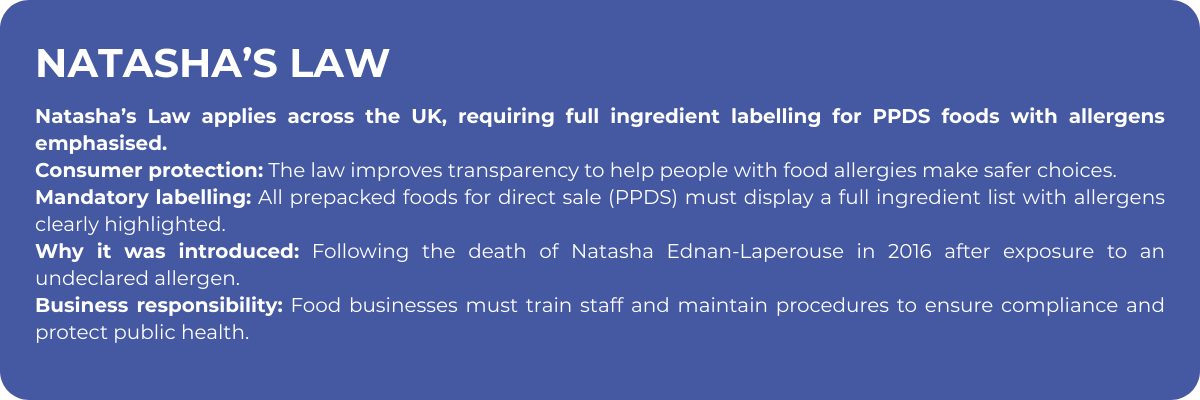
Natasha’s Law is named after Natasha Ednan-Laperouse, a 15-year-old girl who tragically died in 2016 after suffering a severe allergic reaction. She had eaten a baguette containing sesame seeds, an ingredient she was allergic to, which was not clearly listed on the packaging.
At the time, food sold in certain settings was not legally required to display full ingredient lists. Natasha’s death highlighted serious gaps in food labelling rules and led to a nationwide campaign by her family to improve allergen transparency.
As a result, the UK government introduced Natasha’s Law to help prevent similar tragedies in the future.
What Is Natasha’s Law?
Natasha’s Law requires that all pre-packed food for direct sale (PPDS) must display:
- A full ingredients list
- Clear allergen information
- Emphasised allergens (usually in bold)
The law applies across England, Wales, and Northern Ireland, and came into effect on 1 October 2021.
Its main purpose is to ensure that customers with food allergies can make safe, informed choices before purchasing food.
What Is Pre-Packed for Direct Sale (PPDS) Food?
PPDS food refers to food that is:
- Prepared and packaged on the same premises
- Packed before being ordered
- Offered for sale to customers in its packaging
Common examples include:
- Sandwiches made and wrapped in a café
- Salads prepared in a shop and placed in a fridge
- Cakes wrapped on-site and sold at a counter
- Ready-to-go pasta pots or wraps
If the food is packed before the customer chooses it, and sold from the same business, it is likely to fall under PPDS rules.
Which Allergens Must Be Declared?
Under Natasha’s Law, food labels must clearly highlight any of the 14 major allergens, which are:
- Celery
- Cereals containing gluten
- Crustaceans
- Eggs
- Fish
- Lupin
- Milk
- Molluscs
- Mustard
- Nuts
- Peanuts
- Sesame seeds
- Soya
- Sulphur dioxide (sulphites)
These allergens must be emphasised within the ingredients list, usually in bold, capital letters, or a different colour.
Example:
Ingredients: Wheat flour, MILK, sugar, EGGS, butter
Who Must Follow Natasha’s Law?
Natasha’s Law applies to many food businesses, including:
- Cafés and coffee shops
- Takeaways
- Bakeries
- Delicatessens
- Sandwich shops
- Supermarkets with in-store food counters
- Mobile food vans selling pre-packed food
Any business preparing and packaging food on-site for direct sale must comply.
Large retailers and small independent businesses are equally responsible.
How Does This Affect Food Businesses?
For food businesses, Natasha’s Law means stricter responsibilities and higher standards.
Key requirements include:
1. Accurate Recipe Management
Businesses must know exactly what goes into every product. This includes sauces, toppings, marinades, and garnishes.
Any change in ingredients must be updated on labels immediately.
2. Proper Labelling Systems
Labels must be clear, legible, and attached to the packaging. Many businesses now use digital labelling systems or dedicated printers to reduce errors.
3. Staff Training
Staff must be trained to:
- Understand allergens
- Read ingredient lists correctly
- Avoid cross-contamination
- Answer customer questions confidently
4. Cross-Contamination Controls
Even if an allergen is not intentionally added, traces from shared equipment or surfaces can pose serious risks. Good hygiene and separation procedures are essential.
What Are the Penalties for Non-Compliance?
Failing to comply with Natasha’s Law can lead to serious consequences, including:
- Improvement notices
- Fines
- Business closure
- Prosecution
- Reputational damage
Local authorities and environmental health officers are responsible for enforcement and inspections.
Benefits for Consumers
For customers, especially those with food allergies, Natasha’s Law provides greater safety and confidence.
Key benefits include:
- Clear, consistent allergen information
- Reduced reliance on verbal advice
- Lower risk of accidental exposure
- Greater trust in food outlets
This transparency helps people with allergies live more freely and safely.
Common Misunderstandings About Natasha’s Law
Despite being in force since 2021, some confusion still exists.
“Verbal Information Is Enough” – Not for PPDS food. Written labels are legally required.
“Small Businesses Are Exempt” – False. The law applies to businesses of all sizes.
“Only Restaurants Need to Worry” – Incorrect. Any outlet selling PPDS food must comply.
“Handwritten Labels Are Not Allowed” – They are allowed, if they are clear, accurate, and complete.
How Natasha’s Law Fits into Wider Food Safety Rules – Natasha’s Law works alongside existing UK food safety legislation, including:
- Food Safety Act 1990
- Food Information Regulations 2014
- HACCP (Hazard Analysis and Critical Control Points) requirements
Together, these laws aim to protect public health and maintain high standards in the food industry.
Natasha’s Law represents a major step forward in protecting people with food allergies. By requiring full ingredient and allergen labelling on pre-packed food, it reduces uncertainty and saves lives.
For food businesses, it encourages better organisation, training, and transparency. For consumers, it provides confidence, clarity, and peace of mind.
Ultimately, Natasha’s Law reminds us that clear information is not just good practice – it is a legal and moral responsibility.